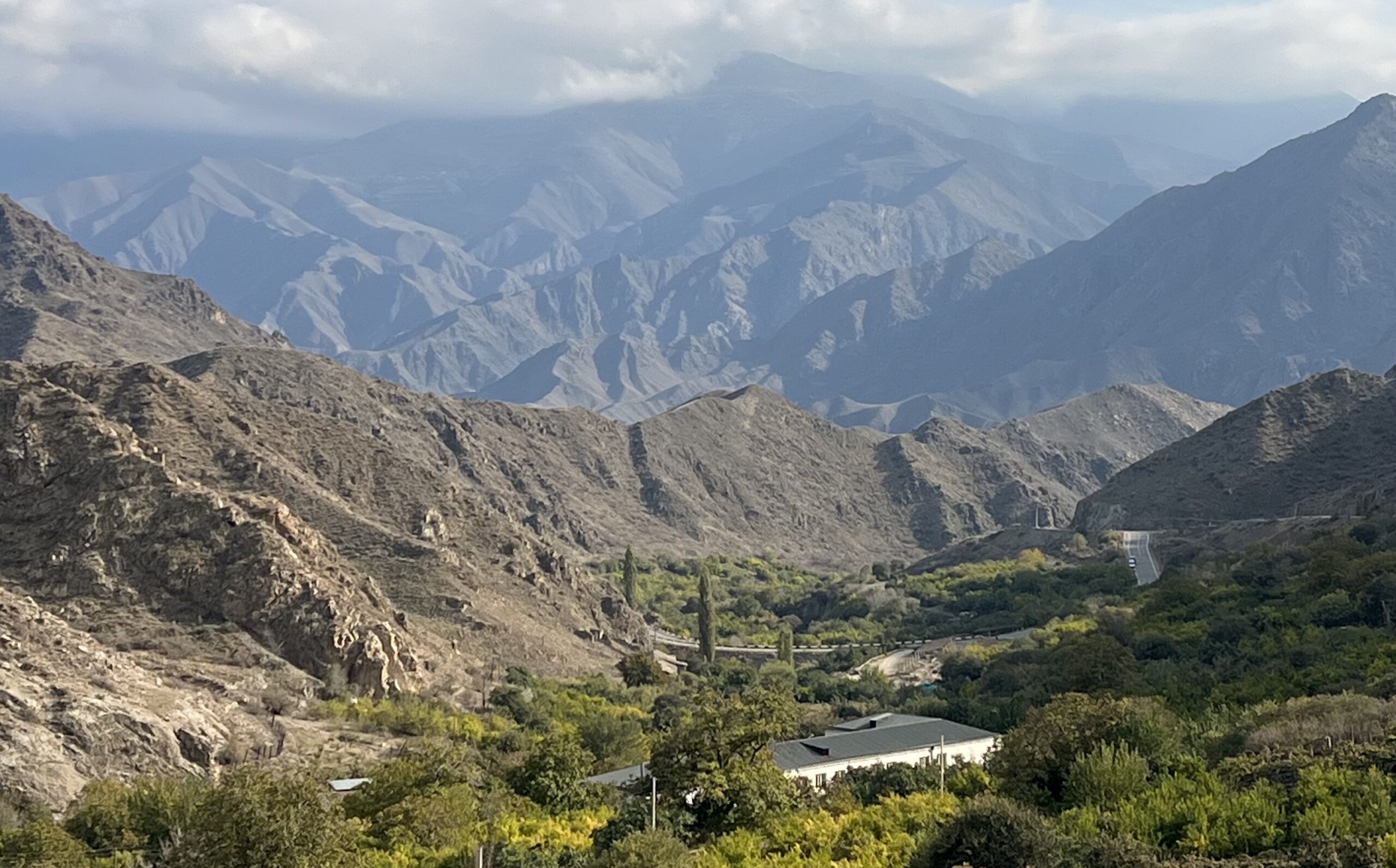
The road to the southernmost part of Armenia will test your resolve as a front-seat passenger. Each time a truck appears in the fog up ahead, lumbering along another curve, you will clutch the door handle of the car, white-knuckled and mouthing a prayer, as your driver speeds past into the haze ahead. Understandably, many Armenians won’t make the journey as lengthy, as expensive, and as treacherous as this one, but somehow, last October was my fourth such drive to Meghri.
The one before had been to report on the hundreds of arrivals from a heavily bombarded Iran. What was hard to ignore at the time were the large groups leaving Agarak, the small border town nearby, and heading into Iran on foot, lugging plastic bags and suitcases for about a kilometer, apparently undeterred by the geopolitical situation unfolding around them. The border here is porous, and this part of the country is so remote that everyday necessities are usually cheaper on the other side of the fence. Hunched over on the same benches where Iranian families waited for a ride to Yerevan were people sitting with their bags and bags of purchases. One man, Harout, showed me a 2,000 dram lighter he had procured across the border. After looking at my camera and credentials, he asked what I was reporting on, and then said incredulously, “We don’t have water in the villages here, why aren’t you reporting on that?”
In a country that seems so intent on wasting water, whether thrown at each other in good fun, pumped by the gallon into thirsty Ararat valley fish farms, or funneled through kilometers of cracked and seeping pipes from the lake to the fields, it’s easy to think we live in an abundance of the stuff. But that couldn’t be further from the reality here, eight long hours away from the gushes of water that spill onto every street corner of Yerevan. Whether it’s bad infrastructure, a climate-related shortage, or an unfortunate combination of the two, unreliable access to drinking water is rather common around the country. One example is in Shvanidzor, a village still 16 kilometers further by car from Meghri, where residents live without regular access to water for several months at a time.
“For people to stay, there has to be water.”
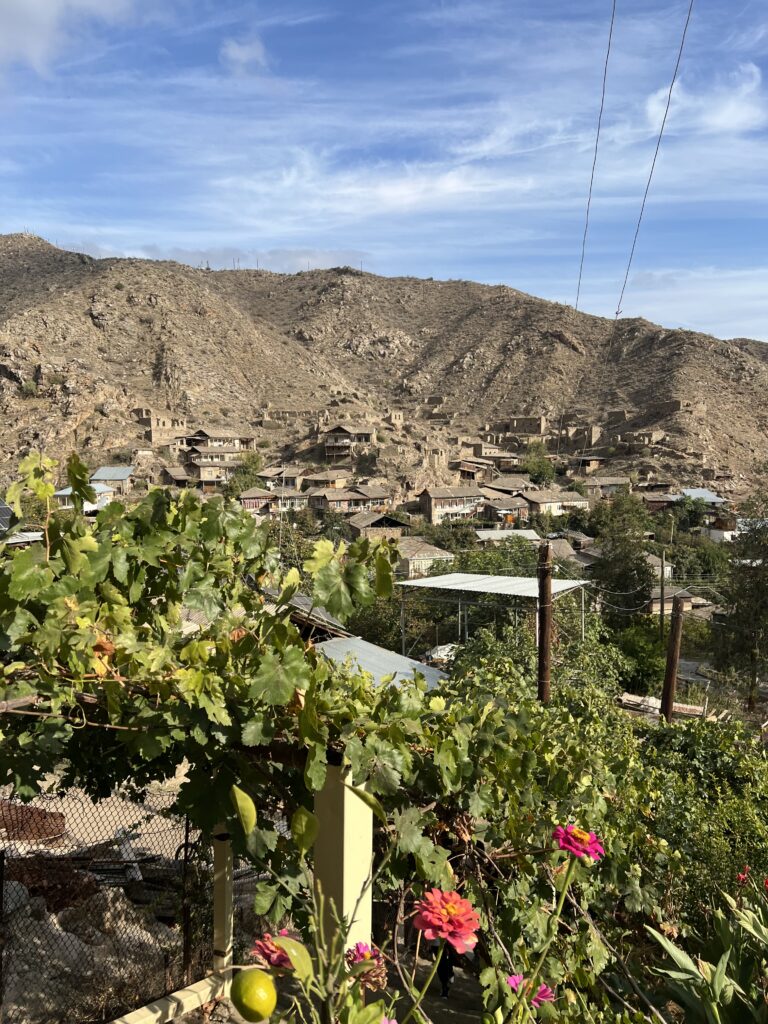
Leaving Meghri, the road to Shvanidzor hugs the Armenia-Iran border. This part of the land is naturally demarcated by the blueish-brown rapids of the Araks River and the sharp, angular cliffs of our southern neighbor. Rows upon rows of pomegranate trees, a defunct train station, and a handful of watch towers are the only landmarks that track the slow bend of the river. Then, turning into the village, the stone houses begin to cluster together on the hillside, connected by narrow lanes too small for cars, and a network of footpaths that only a local could decipher.
Thankfully, my wayfinder is a local named Qnar, an eighteen-year-old born and raised in Shvanidzor whose love for her village is palpable. She runs out of breath narrating each crumbling medieval relic, and we rush to keep up with her, even as she shouts a greeting to every other local we encounter on the road. After a few turns from one stone pathway into another, we arrive at her family home.
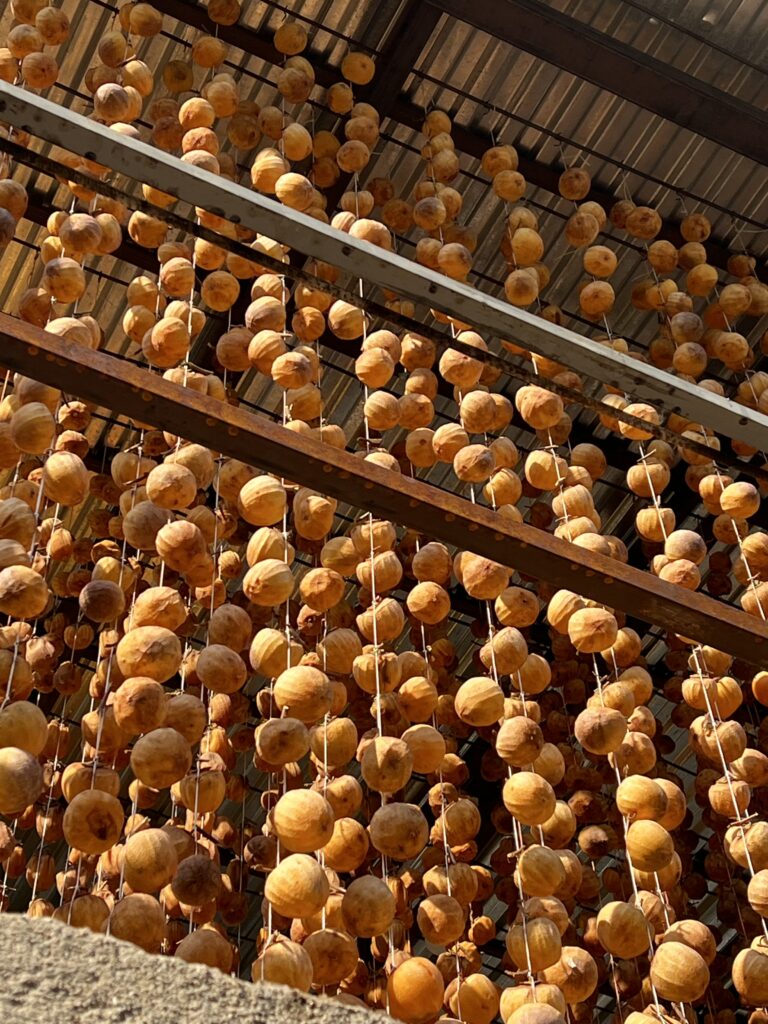
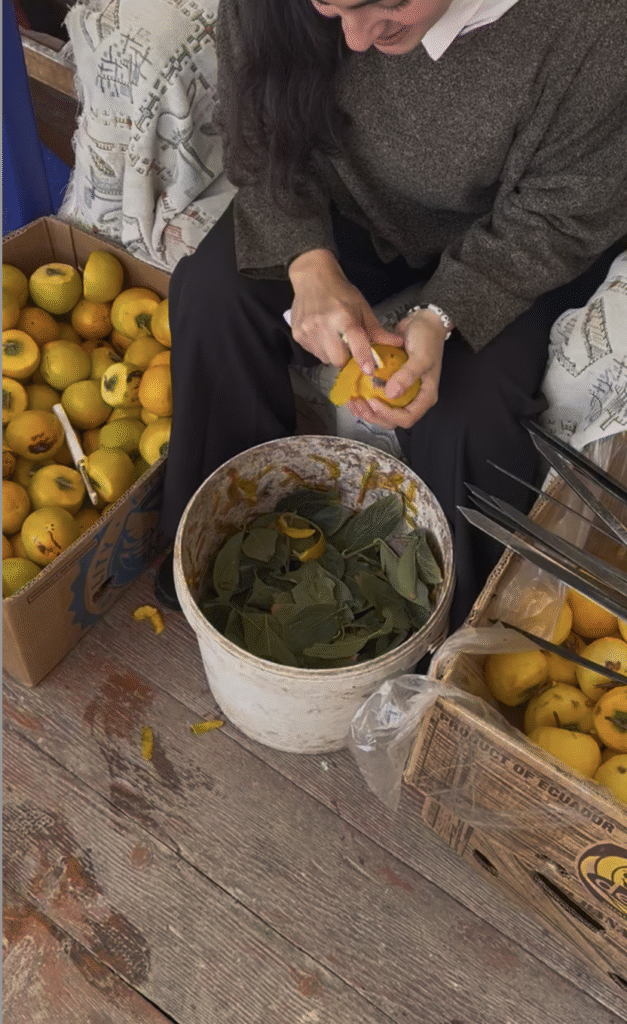
Here, typical of the region and the time of year, there are long strings of freshly-peeled persimmons hanging from the roof all along the balcony like a curtain of pale orange ornaments. Each one is painstakingly tied to a line with a short string wrapped around the stalk. On the terrace, there are buckets and buckets of unpeeled persimmons, waiting their turn to be peeled, hung, and dried. Qnar grabs a knife and quickly slices the skin off one of the fruits. This speedy motion feels like a skill every kid here grows up learning as second nature.
There is a large metal sink opposite where she sits, which, when you twist the knobs, will make the sound of scraping metal but won’t rush out any water from the tap. Instead, there is a blue plastic canister in the basin, and several more stacked underneath. These are filled from a nearby kahreze, sometimes pronounced kyareze, a system of supplying and managing water that dates back to ancient Persia.
This system usually has a series of vertical shafts dug down towards the water table, linked by a sloped tunnel that coaxes water forward. Most of the kyarezes in the village date back hundreds of years, but the medieval ingenuity has outlived the people who know how to reliably repair them. There are five around town, only two work reliably to provide drinking water, and really only in the colder months.
In early October, the one we walked past before reaching Qnar’s house is barely a trickle, though in summer it usually dries out entirely. The water that supplies the system comes from mountain reserves and seasonal snow melt, so when the heat of July and August comes around, and temperatures sometimes reach over 40 degrees celcius, it’s usually all dry. When Qnar describes living here in those months, the reality is not glamorous. Water is used extremely sparingly, and almost every mundane action has to be calculated and thought out — showering, washing hands, laundry, food preparation. And when the wells do eventually dry out, those who have the means make the 16-kilometer trip to Meghri or to another village nearby with a functioning water source. They go to the mountain springs, or down to the old Soviet-era wells along the banks of the Araks River. They fill water in large plastic containers, hoist them into the trunks of cars, and lug them back up the stone staircases and laneways of the village. Unable to stay in these conditions, many people leave the village in these months.
Making do with this temperamental supply of water has forced the village to scale down. There are no longer any farm animals, because, of course, cows and sheep need water. No animals means no fresh produce. “Why should we have to go all the way to Meghri to get yogurt?” says Qnar. “These things aren’t made here anymore because of the water shortage.”
Small-scale agriculture, which sustains the town and provides the livelihood of virtually every family that lives there, uses river water as well as the flows from an impressive medieval aqueduct. A steep bridge at the edge of the town, made of basalt and lime mortar, funnels water that’s too salty to drink to the small plots of pomegranates and figs that almost every family keeps.
The water coming from the kahrezes was chlorinated a few years ago, and there’s momentum to modernize the system even more. A philanthropic organization expressed interest in funding the drilling of deep boreholes to tap into clean groundwater, with a pipeline to run several kilometers up to the village, but after preliminary research, it did not move forward with the project. One resident told me the project had a funding shortfall.
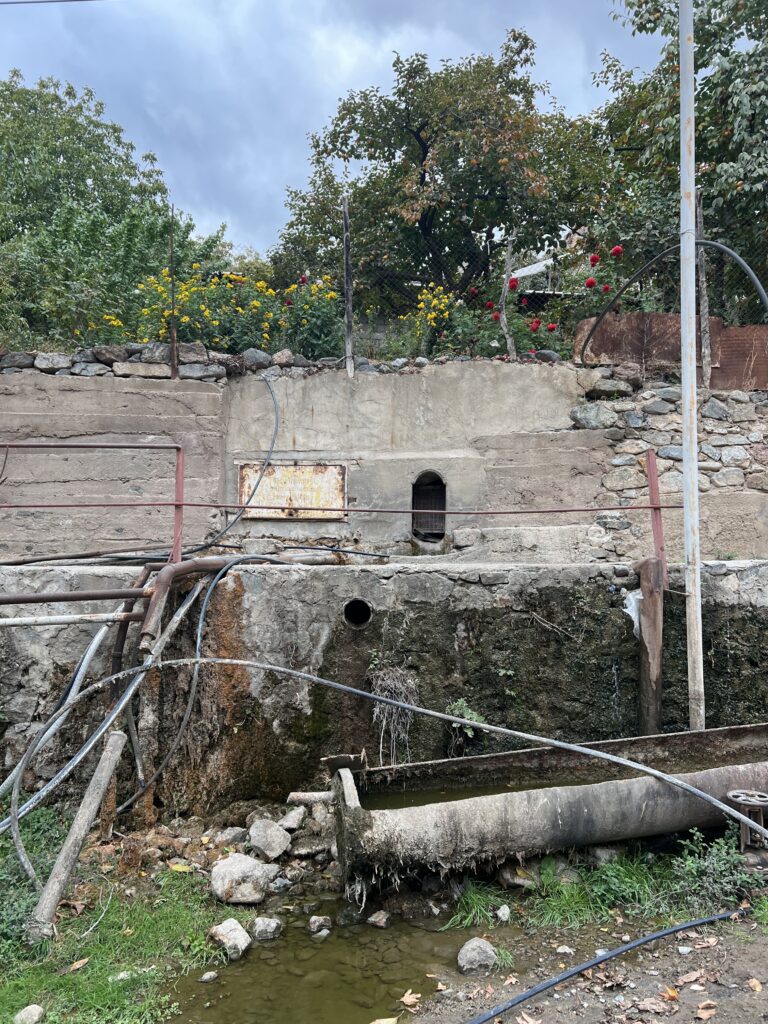
For now, villagers are looking to the government for action after the Prime Minister visited the region last year, but no concrete steps addressing the water shortages have followed. When we walked along the main road of Shvanidzor, we spotted stacks of wide blue pipes beside one of the kahreze openings, part of an effort to upgrade the village’s irrigation infrastructure, drawing water from the river to keep the gardens alive. Whether these will supply drinking water as well remains to be seen.
Shvanidzor, and similar villages dotted around the area, face the existential calculation that a lack of water and such drastic remoteness will bring. For people to stay, there has to be water.