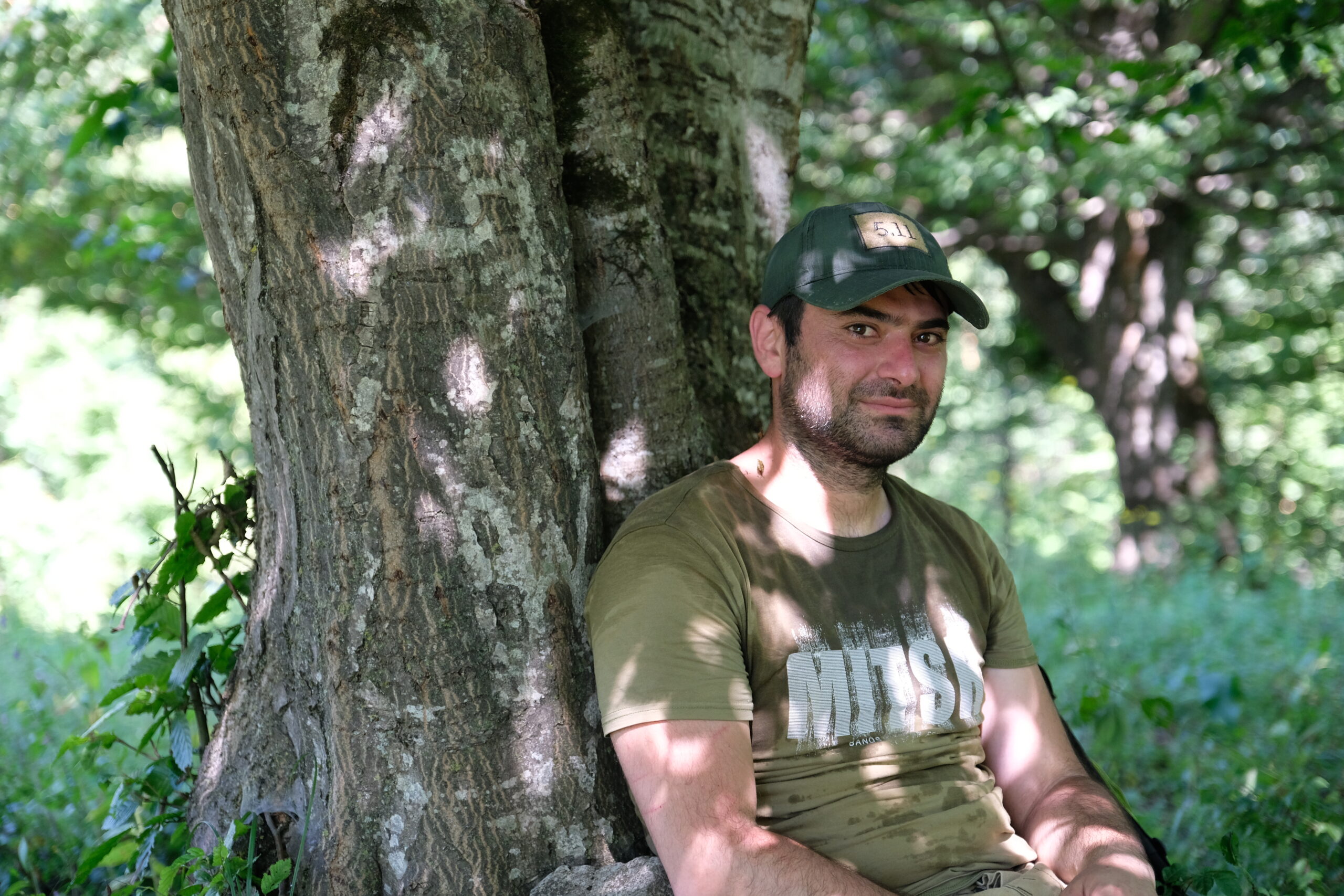
When I said I would write about illegal logging in Armenia, I didn’t picture myself ankle-deep in mud, laboring up a steep mountainside near Dilijan with thorns scratching at my bare arms and hands. The evidence for my story could be found in a forest near Teghut, where one of the 4×4 roads leading up to Dimats mountain, a popular tourist spot some might be familiar with, cuts through the hillside.
I was following a ranger named Hovo Tonoyan who navigates these dense forests with the same ease that some people might take an effortless walk through their neighborhood. He also motorbikes through these woods, and has a deep, bloody gash on his left arm to show for it. Some of the GPS coordinates are more than several kilometers from any decent road, and a motorbike, however dangerous a loose rock or unexpected drop might be, is the only viable way to get to these remote locations.
Phone in hand, Tonoyan scrutinized each discernable change in slope on a topographical map, judging whether we should take the wide, rocky path that would add hours to the route, or the impossibly steep shortcuts through the wilderness. More often than not, it was the latter. He put up with my complaints for the two or so hours we spent trudging upwards while I was wondering why we didn’t just settle for a phone call instead. But when we finally reached a slight clearing, wheezing and bruised, we found what we came here looking for.
Behind the cover of bushes and tangled branch, were several large, flat tree stumps. Some were scorched on top and blackened, because someone had tried to cover their tracks by making the felled trees seem older than they were. But the sawdust still at the base of the severed stump gave away the crime. Tonoyan leaned over to examine each one, reaching for a ruler to measure the width, and taking note of its coordinates to log each illegally felled tree on a comprehensive map of Tavush’s forests.
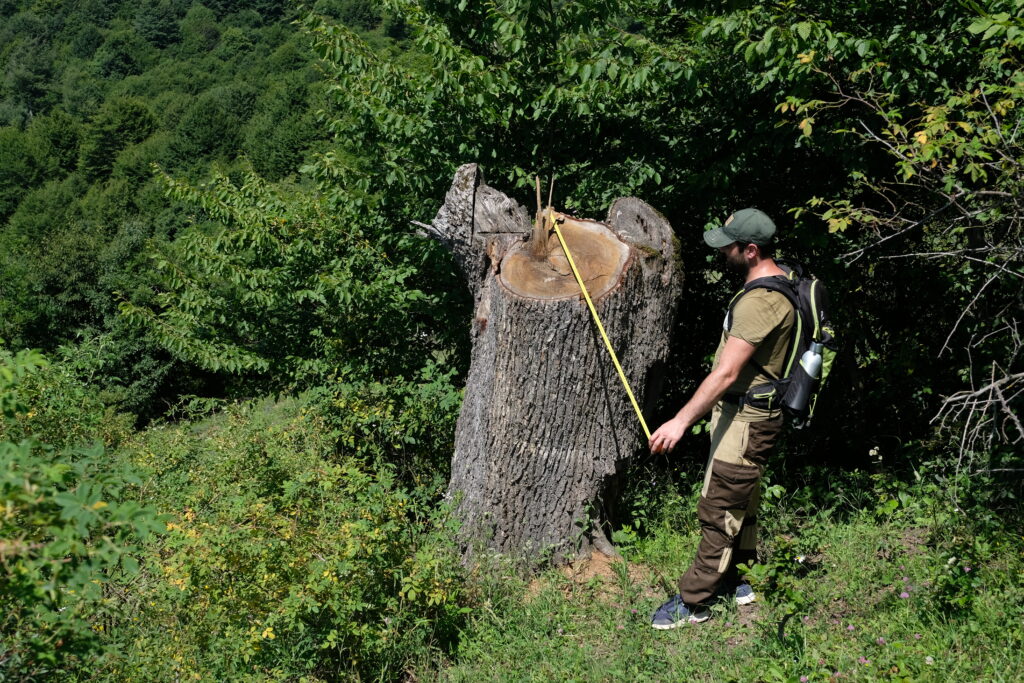
Armenia’s green cover is disappearing much faster than people realize. In the relatively small area we scouted, we spotted at least 30 recently felled trees. Rather than the dramatic deforestations that seem to happen overnight in other parts of the world, here, individuals and small groups of opportunistic businessmen have been chipping away at forests for decades, take one tree here and one tree there. Such a steady loss of trees has thinned out the forests, and at times, left entire hillsides bare.
In Dilijan alone, activists estimate that at least 2,000 trees are cut illegally each year to feed the demands of household heating and commercial interests like furniture making. The loss of trees has ecological impacts that will take generations to recover, such as destabilizing soil, drying up village water resources and hollowing out forests that grew over hundreds of years. Some working on the issue here told me the village of Teghut already has several wells that no longer function because the trees, now gone, were acting as a kind of natural plumbing system.
According to them, the beginnings of the logging crisis goes back to the well-documented energy shortages of the 90s, when firewood became one of the most important sources of heat for many households. Three decades later some of the underlying issues still exist. Gas remains expensive for many families, enforcement of the laws forbidding logging is weak and if perpetrators are caught, court cases rarely go anywhere, and convictions are rare. For example, some forestry officials have even been accused of taking bribes from illegal logging networks, or themselves participate in the crimes.
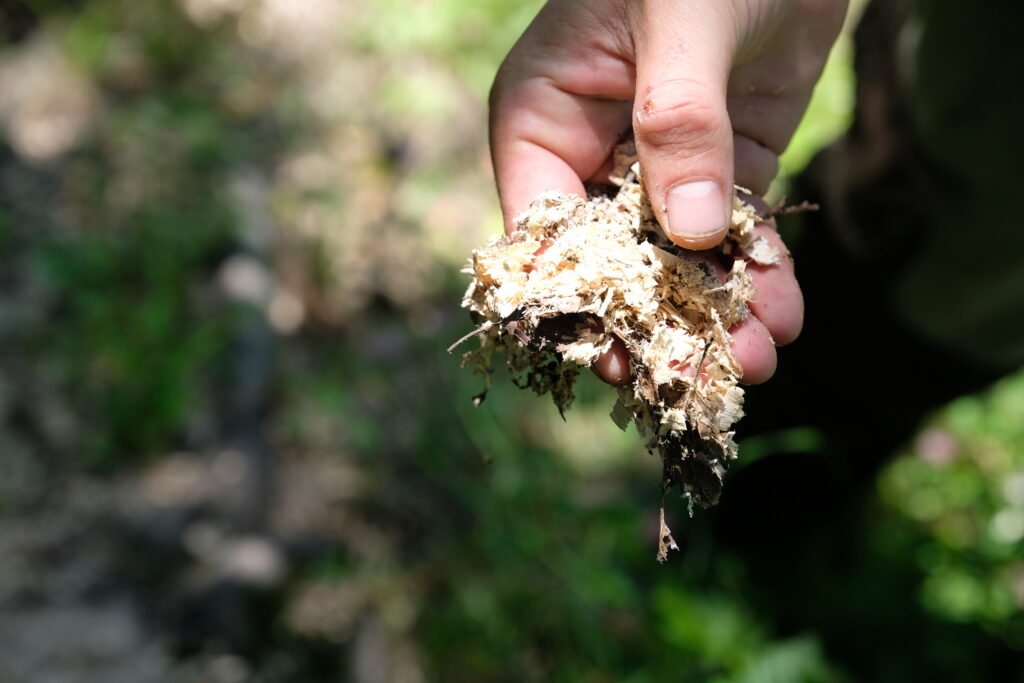
The tactics have become more advanced and harder to spot, too. Tonoyan showed me how loggers poison trees to make their death seem natural, putting a poison directly into the roots to kill the tree from the inside. After this, it usually topples over in a few months, seeming as if it died a natural death. Loggers also hide the stumps under soil, or move through hundreds of meters of brush to obtain trees further in the thick of the forest, and therefore more difficult to scout.
The largest stump we see is about thirty meters below us, a dizzyingly steep downhill through more branches, thorns, and mud. Struggling with camera gear and a backpack of supplies on this terrain, it’s hard to imagine a group of men lugging a several-hundred-year-old oak tree through these impossible woods in the middle of the night. But the reason they do is obvious, a single tree can sell for over $2,000, a strong incentive to continue.
I went to document the destruction, but also to understand the plight of the people working to put an end to it. Tonoyan is out in the forest most days, patrolling on foot or on bike, and hunting for the newest tree fellings either via a tip off from a villager or by following the sound of chainsaws in the night. He’s a member of Bnapahpani Toon (or Eco-Patrol). The group has only four or five volunteers at any given time, plus drones, camera traps and a fleet of motorbikes, but over the past few years, have managed to cut illegal logging by half in the area, according to their determined founder, Gor Hovhannisyan. When he started back in 2017, he told me he could hear chainsaws every evening from his porch overlooking the forests below Haghartsin monastery. Now, he says the sound is rare.
These eco-patrollers have been chased, threatened and even attacked by loggers and their supporters. When we drove into the village, we certainly didn’t receive a warm welcome from anyone standing around outside, even though it was obvious they recognized Tonoyan. But other locals are in on it, and quietly support the work by passing along information about neighbors and newcomers who they suspect are logging.
Watching this small group of people putting boots and wheels on the ground puts into perspective the work that goes on behind the scenes. Very often, telling the news about the environment involves reporting on what happens around conference tables, but overlooks the unglamorous work being done far off in the forests themselves. That’s where the determination of just a few can make a real difference in slowing the destruction of Armenia’s green cover.
And stopping the damage is only one part of the story, a handful of projects are putting new roots into the soil as well. Groups like My Forest Armenia and the Armenia Tree Project plant thousands of trees each year. While the work is slow and will take years, these small steps repeated often enough and widely enough can slow the destruction of our landscape.